
Adam and Eve
Genesis 2
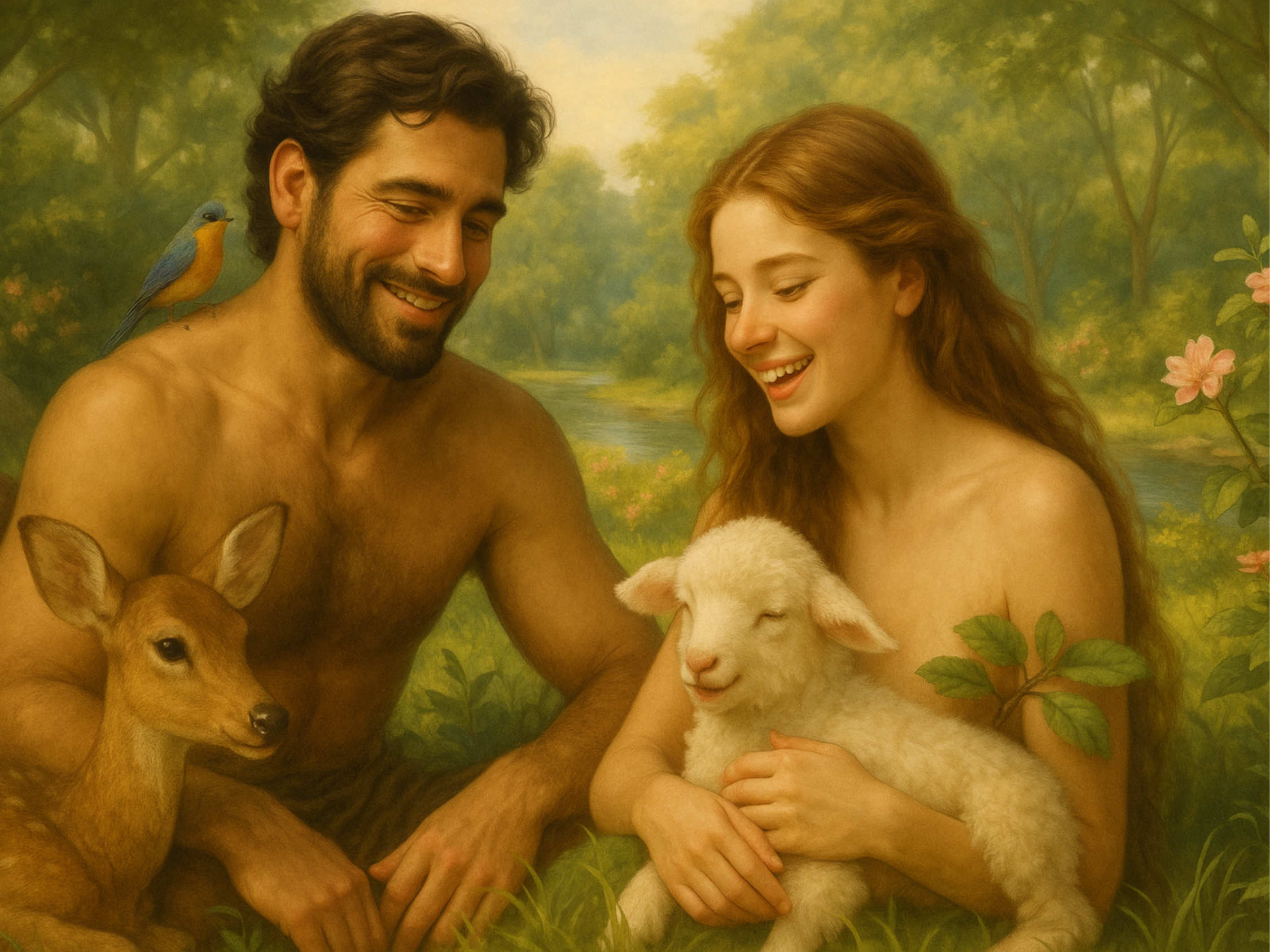
Before there was sin, sorrow, or separation, there was Eden. Genesis 2 slows the story from the wide view of creation to a close, personal focus on God’s relationship with humanity. Instead of simply declaring man into existence, God chose to form him with His own hands. Scripture tells us, “And the LORD God formed man of the dust of the ground, and breathed into his nostrils the breath of life; and man became a living being.” (Genesis 2:7). Nothing else in creation receives this level of intimacy. Mountains rise at His command, stars appear at His word, but humanity is shaped, held, and filled with God’s own breath. To live was not only to move or think, but to be loved and known by the God who created us.

Once Adam was formed, God did not leave him in a barren world. He planted a home for him with care and beauty. “The LORD God planted a garden eastward in Eden, and there He put the man whom He had formed.” (Genesis 2:8). Eden was not wild or empty, but full of provision. Scripture says, “Out of the ground the LORD God made every tree grow that is pleasant to the sight and good for food.” (Genesis 2:9). God created a place that nourished both body and spirit. The garden offered beauty to behold and fruit to enjoy. Rivers flowed with life, and precious stones were set in the earth. This was not survival—this was peace, delight, and rest in God’s presence.

God then invited Adam into partnership, not through labor or conquest, but through naming the creatures of the earth. “Whatever Adam called each living creature, that was its name.” (Genesis 2:19). The naming was gentle and relational, a way of understanding creation and understanding himself. Yet in all the creatures brought before him, none matched Adam’s own nature. Scripture states, “But for Adam there was not found a helper comparable to him.” (Genesis 2:20). This was not a desperate loneliness, but the quiet recognition that humanity is designed for companionship.
Although God knew Adam needed a companion, He allowed Adam to discover that need on his own. As each creature passed before him, Adam realized that none shared his nature, his language, or the image of God he carried. This was not loneliness as punishment, but longing as preparation. God was shaping Adam’s understanding so that when He finally brought Eve to him, she would not simply be another creation in the garden, but a wondrous gift, ideally suited, deeply treasured, and joyfully received. If she had been created at the exact moment as Adam, he might never have recognized her value, nor seen the beauty of human relationships as God designed them. By learning what no creature could be, Adam learned to love what only Eve could be — a companion equal in dignity, shared in likeness, and welcomed beside his heart.

God answered Adam’s need with tenderness. “The LORD God caused a deep sleep to fall on Adam… and He took one of his ribs… and made it into a woman.” (Genesis 2:21–22). She was not formed from dust, but from Adam’s own side. She was not made beneath him or above him, but beside him, close to the heart. When Adam awakened and saw her, his first recorded words in Scripture were not instructions or judgment, but joy: “This is now bone of my bones and flesh of my flesh.” (Genesis 2:23). In that moment, relationship itself was created—equal, pure, and full of delight.
Here God established the covenant of marriage: “Therefore a man shall leave his father and mother and be joined to his wife, and they shall become one flesh.” (Genesis 2:24). This union was not marked by fear, struggle, shame, or competition. It was unity given by God as a blessing, a harmony that reflected God’s own love and design. The chapter closes with a sentence that reveals the purity of this first relationship: “They were both naked, the man and his wife, and were not ashamed.” (Genesis 2:25). Nothing was hidden. Nothing was broken. Nothing wounded the heart.

Genesis 2 invites us to remember the world as it was before sin changed it—before distrust, pain, toil, grief, and distance. Eden was not a test to pass, but a home shared with God. He walked with humanity, provided for them, gave work that was joyful instead of heavy, and created companionship that was marked by dignity and love. As we move forward in Scripture and witness the sorrow of Genesis 3, it is essential to hold this picture close. Before the fall, there was only peace. Before the exile, there was only belonging. Before the heartbreak, there was only love.

Eden shows us what God desired for His creation: fellowship without fear, relationship without shame, and life lived with Him, not apart from Him. Though this perfect closeness will soon be disrupted, Scripture assures us that God has never abandoned His plan to restore what was lost. For now, Genesis 2 allows us to pause in the quiet beauty of the beginning—where humanity walked with God, creation rested in harmony, and love was unbroken.
LEARN POST 2 — BIBLE STUDY OUTLINE
“Formed from Dust, Breathed by God” Genesis 2
I. God Forms Humanity With Intimacy
Genesis 2:7
“And the LORD God formed man of the dust of the ground, and breathed into his nostrils the breath of life…”
Humanity is not spoken into existence like the rest of creation.
God forms → personal involvement, intentional design.
God breathes → life is sacred and relational, not mechanical.
Key Truth:
Human dignity begins not in what we do but in who made us and how He made us.
Discussion Point:
What does God’s direct touch say about His desire for closeness with humanity?
II. Eden: A Garden Prepared in Love
Genesis 2:8–9
“The LORD God planted a garden eastward in Eden… pleasant to the sight and good for food.”
The word planted shows care, not detachment.
Beauty matters to God (pleasant to the sight).
Provisions matter to God (good for food).
Key Truth:
God did not create humanity and then find a place for us — He made the place and then gently placed us in it.
Application:
God is not only Creator; He is Host and Father.
III. Naming the Animals: Learning Who He Was
Genesis 2:19–20
“Whatever Adam called each living creature, that was its name… but for Adam there was not found a helper comparable to him.”
Naming is relational, not domination.
Adam discovers the difference and his own uniqueness.
No animal shares his likeness, language, or image-bearing identity.
Added Insight:
God allows Adam to realize his need so he will recognize the gift when she arrives.
Key Truth:
God forms desire before He fulfills it, so His gifts are received with worship, not entitlement.
IV. The Creation of Eve: Gift, Equality, and Joy
Genesis 2:21–23
“He took one of his ribs… and made it into a woman… ‘This is now bone of my bones…’”
Eve is made from Adam, but not beneath or above him.
Hebrew for “made” (banah) means designed with care, built with beauty.
Adam’s response is poetry, not a command.
Key Truth:
Adam does not seize Eve — he receives her.
Discussion Point:
Why was Eve made after Adam’s realization and not alongside him?
V. Marriage as God’s Covenant of Unity
Genesis 2:24
“A man shall leave his father and mother, and be joined to his wife, and they shall become one flesh.”
God, not culture, creates marriage.
Union, not hierarchy.
Oneness, not ownership.
Key Truth:
Marriage begins in joy, equality, and peace—not domination, suspicion, or shame.
VI. Innocence Without Shame
Genesis 2:25
“They were both naked… and were not ashamed.”
A world without defensive walls or emotional armor.
Nothing hidden, nothing feared.
Perfect trust, perfect belonging.
Key Truth:
Genesis 2 must be felt before Genesis 3 is understood.
Fall is tragic only because Eden was precious.
VII. Theological Reflection
Humanity is handcrafted.
Work was a delight, not a burden.
Animals were companions, not threats.
Marriage was mutual joy, not rivalry.
God walked with His people without a veil or distance.
Optional Christ Tie-In for the End (gentle):
Where Adam failed, Christ succeeds — restoring communion, union, and rest.
VIII. Discussion Questions
What does God’s method of forming Adam teach us about His character?
Why is it important that Adam name creation before receiving Eve?
How does Genesis 2 correct the idea that God is distant or demanding?
What does “bone of my bones” reveal about the nature of marriage?
What does “not ashamed” look like emotionally, not just physically?
IX. Take-Home Reflection
Invite the group to sit with this thought:
Eden was our first home, made with love, filled with peace, and shared with God.
The pain of losing it will only be understood if its beauty is first remembered.
