
How the Old Testament Was Preserved
Ancient Copies, Careful Scribes, and the Words That Survived
“The grass withers, the flowers fade, but the word of our God remains forever.”
— Isaiah 40:8 (CSB)
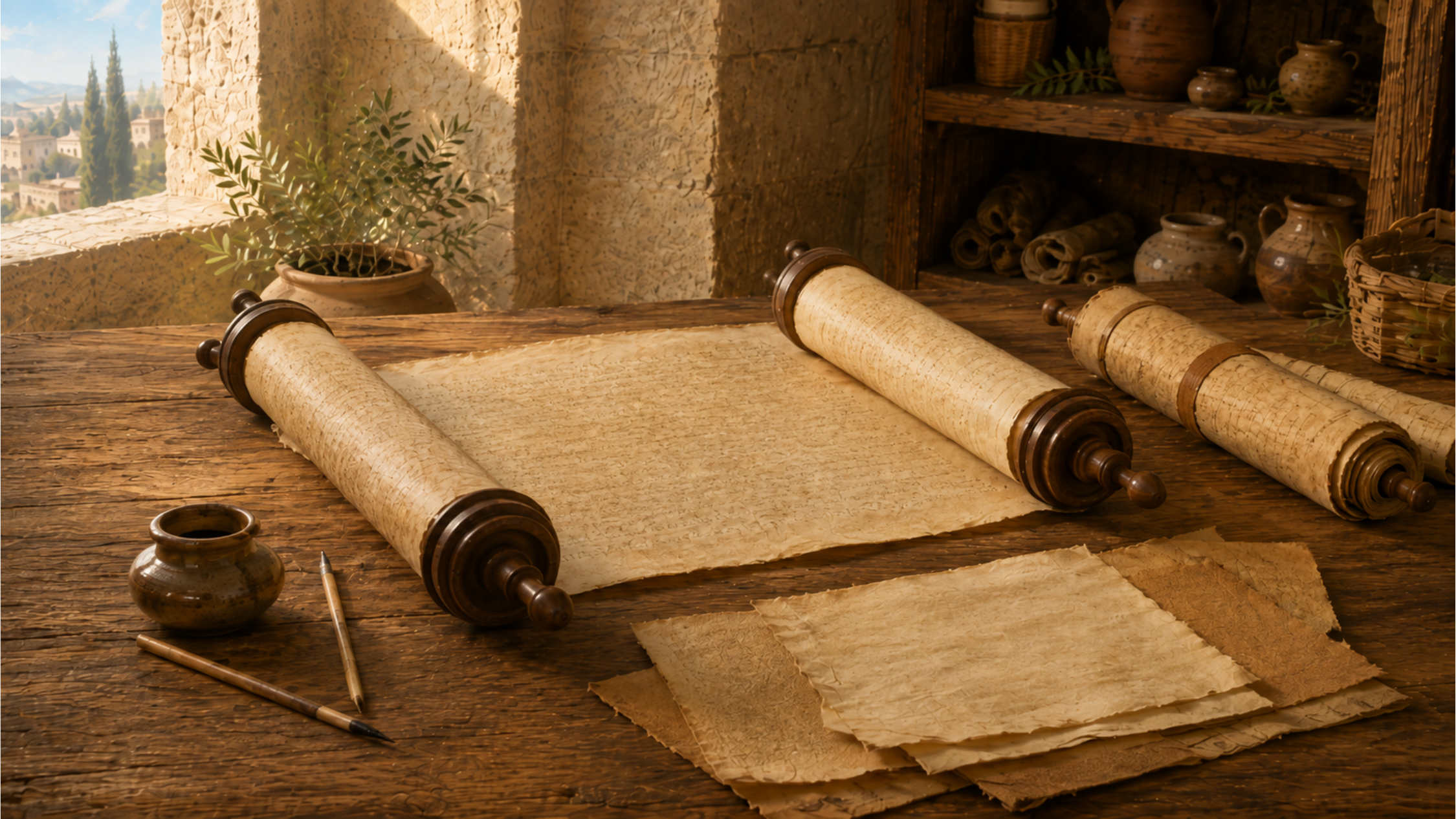
When we hold an Old Testament today, it is easy to forget just how old many of its words are.
The books of the Old Testament were written long before printing presses, computers, or even paper as we know it. For centuries, every copy had to be made by hand. Scrolls wore out. Languages changed. Kingdoms rose and fell. Jerusalem was conquered more than once, and the Jewish people were scattered into different parts of the ancient world.
Yet the Scriptures survived.
That does not mean every handwritten copy was perfectly identical. As we saw in the last chapter, human beings copied these writings, and human beings can make mistakes. What is remarkable is that enough ancient copies and different textual traditions survived that scholars can compare them and see both where the wording remained remarkably stable and where differences developed.
The preservation of the Old Testament is not a story of one perfect manuscript being passed untouched from generation to generation. It is the story of many generations carefully preserving, copying, translating, and comparing words they believed were worth keeping.
The Scriptures Had to Be Copied Again and Again
Ancient scrolls did not last forever. They were handled, rolled and unrolled, carried from place to place, and exposed to the ordinary wear of time. When a scroll became old, another copy had to be made.
Imagine copying the entire book of Isaiah by hand. There was no copy-and-paste, no spelling checker, and no machine making a second copy while you waited. Someone had to sit down and carefully reproduce one word after another.
That work required patience.
Jewish scribes developed traditions for copying sacred texts with great care because they believed the words mattered. Over time, especially in later Jewish scribal traditions, detailed practices were used to help protect the text from careless changes.
Even so, no honest history of the Bible should claim that every copy came out exactly alike. Small differences appeared, just as we would expect whenever long documents are copied by hand over many centuries.
“When Moses had finished writing down on a scroll every single word of this law…”
— Deuteronomy 31:24
Even within Scripture itself, we see written words being deliberately recorded and preserved for those who came afterward.
What matters is that we have evidence of those differences.
We can compare the copies.
The Dead Sea Scrolls Changed What We Could See
For a very long time, some of the oldest complete Hebrew manuscripts available to scholars came from the medieval period. Then, beginning in 1947, ancient scrolls and fragments were discovered in caves near the Dead Sea.
These became known as the Dead Sea Scrolls.
Among them were copies or fragments of many books from the Hebrew Scriptures, along with other Jewish religious writings. Some of these biblical manuscripts were roughly a thousand years older than the medieval Hebrew manuscripts scholars had previously relied upon.
That gave researchers an extraordinary opportunity.
They could compare much older copies of Scripture with the Hebrew text preserved many centuries later.
And in many places, the wording was strikingly similar.
That does not mean the Dead Sea Scrolls proved that every word had been copied without any change. They did not. The scrolls also preserve differences in spelling, wording, and sometimes larger textual forms.
What they showed was more interesting than a simple claim that “nothing ever changed.”
They showed that much of the Hebrew biblical text had been preserved with remarkable continuity while also revealing that more than one textual form sometimes circulated in the ancient Jewish world.
Both facts matter.
Isaiah Gives Us a Wonderful Example
One of the best-known discoveries among the Dead Sea Scrolls is a nearly complete scroll of Isaiah, often called the Great Isaiah Scroll.
For anyone interested in the Scriptures Jesus knew, Isaiah is especially important because Jesus quoted from Isaiah and even read from an Isaiah scroll in the synagogue at Nazareth.
The ancient Isaiah scroll found near the Dead Sea dates from centuries before the medieval Hebrew manuscripts that had long been used for comparison. It is generally dated to roughly the second century BC, often around 125 BC. When scholars compare them, they find many differences in spelling and some differences in wording, but the overall text is very recognizable.
Isaiah did not somehow turn into a different book over those centuries.
That should give readers some perspective. Hand copying introduced differences, but it did not normally mean scribes were rewriting entire books according to whatever they happened to believe.
The Masoretic Text
Another name readers may come across is the Masoretic Text.
The Masoretic Text is the Hebrew textual tradition that became the main basis for most modern translations of the Old Testament. It was preserved and carefully copied by Jewish scholars known as the Masoretes, especially during the early medieval period.
The Masoretes did more than simply copy consonants. Hebrew had traditionally been written mainly with consonants, and readers knew how words were pronounced from language and tradition. The Masoretes developed systems of vowel marks and other notes to preserve pronunciation and reading traditions more carefully.
Their work became extremely influential.
When a modern Bible translation says that its Old Testament was translated from the Hebrew, the Masoretic tradition is usually very important to that work.
But scholars do not simply open one Masoretic manuscript and ignore everything else.
They compare it with other ancient witnesses.
More Than One Witness
This is one of the most useful ideas to understand about the preservation of Scripture.
We do not have only one line of evidence.
The Masoretic Text is very important, but scholars can also compare it with the Dead Sea Scrolls, the ancient Greek Septuagint, the Samaritan Pentateuch in the books of Moses, and other ancient translations and quotations.
Sometimes these witnesses agree closely.
Sometimes one preserves a wording that differs from another.
When that happens, scholars ask which reading is most likely earlier and how the difference may have developed.
This may sound complicated at first, but there is actually something reassuring about it. If we possessed only one ancient copy, we would have no way to know whether a mistake had slipped into it.
Having several witnesses gives us something to compare.
What About the Septuagint?
We will look much more closely at the Septuagint in the next chapter, because it deserves a chapter of its own.
For now, the important thing to know is that Jewish Scripture was translated into Greek beginning before the time of Jesus. That Greek translation gives us another ancient witness to the wording of the Hebrew Scriptures.
Sometimes the Septuagint is very close to the Hebrew text later preserved by the Masoretes. In other places, it differs.
There can be several reasons for that. A Greek translator may have understood a Hebrew expression differently, or the translator may have been working from a Hebrew manuscript whose wording was slightly different from the manuscript tradition that later became standard.
That second possibility became much easier to appreciate after the discovery of the Dead Sea Scrolls, because some of those Hebrew manuscripts contain readings that are closer to the ancient Greek translation.
So when ancient texts differ, we should not immediately assume someone deliberately changed the Bible.
Sometimes we are simply seeing different branches of a very old manuscript history.
The Samaritan Pentateuch
There is another ancient witness worth mentioning briefly.
The Samaritan Pentateuch contains the five books of Moses—Genesis through Deuteronomy—as preserved by the Samaritan community.
Samaritans and Jews had a long and sometimes difficult history with one another, something we can even see in the New Testament. Their communities preserved somewhat different forms of the Torah.
The Samaritan Pentateuch contains many readings that are close to the Jewish Hebrew tradition and others that differ.
We do not need to go deeply into those differences here. Its importance for our story is simply that it gives scholars another ancient form of the Torah to compare.
Once again, we are not dependent upon one manuscript sitting alone.
What Do Manuscript Differences Look Like?
When people hear that ancient biblical manuscripts contain differences, their imagination can run away with them. It can sound as though one scroll teaches one religion while another teaches something entirely different.
Most differences are nothing like that.
Many involve spelling, word order, repeated words, omitted words, or slightly different ways of saying the same thing. Some differences are more substantial and deserve careful study, but those are much less common.
There are also places where an ancient translation or manuscript helps scholars see that a passage may have existed in a somewhat different form at an earlier time.
We should not hide those places.
But we should not exaggerate them either.
A small copying difference does not mean the whole Old Testament is uncertain any more than finding a spelling difference in two old copies of a letter means we no longer know what the letter said.
Context matters.
Preservation Does Not Mean Nothing Ever Changed
This is one place where I think Christians sometimes make things harder than they need to be.
We may hear someone say, “The Bible has been copied perfectly, word for word, without a single change.”
That sounds reassuring. The problem is that the surviving manuscripts themselves show that it is too simple.
Differences exist, and we can see them.
Acknowledging them does not weaken Scripture. It simply means we are being honest about how handwritten texts were preserved.
A better way to say it might be this:
The Old Testament was copied by human hands over many centuries. Those copies contain differences, but the surviving manuscript evidence allows us to compare them and see how faithfully the text was preserved.
That gives us confidence based on evidence rather than confidence that requires us to ignore the evidence.
The People Who Preserved These Words
It is also worth remembering that manuscripts do not copy themselves.
Behind every ancient scroll was a person.
We do not know most of their names. Some may have copied Scripture as a religious calling. Others may simply have been skilled scribes doing the work their community needed. Either way, generation after generation continued making copies because these writings mattered to them.
There is something rather humbling about that.
Someone sat by lamplight and copied words that you and I can read today.
Someone preserved Isaiah before Jesus read Isaiah in the synagogue.
Someone else copied Isaiah centuries later.
Others preserved Psalms, Genesis, Deuteronomy, Jeremiah, and the rest.
Their copies were not always perfect, but without their work we would have very little to study.
How Does This Connect to Jesus?
For our purposes, the ancient manuscript evidence helps us move closer to the world Jesus knew.
When Jesus quoted Deuteronomy in the wilderness or read Isaiah in the synagogue, He was drawing from Scriptures that had already been copied and preserved for generations.
“The scroll of the prophet Isaiah was given to him, and unrolling the scroll, he found the place where it was written…”
— Luke 4:17
The Dead Sea Scrolls are especially valuable because many of them come from the centuries just before and around the time of Jesus. They allow us to see actual biblical texts from that world rather than simply imagining what those texts might have looked like.
They also remind us of something we will keep encountering throughout this series: the Scriptures Jesus knew existed within a living Jewish world where texts were copied, translated, studied, and sometimes preserved in slightly different forms.
That does not make Scripture less meaningful.
It makes its history real.
What We Can Say With Confidence
We cannot honestly say that every surviving Old Testament manuscript is identical, because it is not.
We also cannot say that centuries of copying left the text hopelessly confused, because the evidence does not support that either.
What we have is a large body of ancient evidence showing both careful preservation and normal handwritten variation. The Masoretic tradition gives us a remarkably detailed Hebrew text. The Dead Sea Scrolls take us much farther back in time. The Septuagint, Samaritan Pentateuch, and other witnesses allow scholars to compare different branches of the textual tradition.
Together, they give us a much fuller picture than any single manuscript could.
Perhaps that is the most important thing to remember.
We do not have to choose between saying, “Every copy is exactly the same,” and saying, “We have no idea what the Old Testament originally said.”
The truth is more reasonable than either extreme.
The Scriptures were preserved through real history by real people, and enough evidence survived for us to examine that history carefully.
In the next chapter, we will look at one of the most important parts of that story: the ancient Greek translation known as the Septuagint. It was already in use before Jesus was born, and it would become deeply important to the first Christians and to our later questions about which books belonged in Scripture.
