
Before There Was a Bible
Scrolls, Languages, and the World of Scripture
“He came to Nazareth, where he had been brought up. As usual, he entered the synagogue on the Sabbath day and stood up to read.”
— Luke 4:16 (CSB)
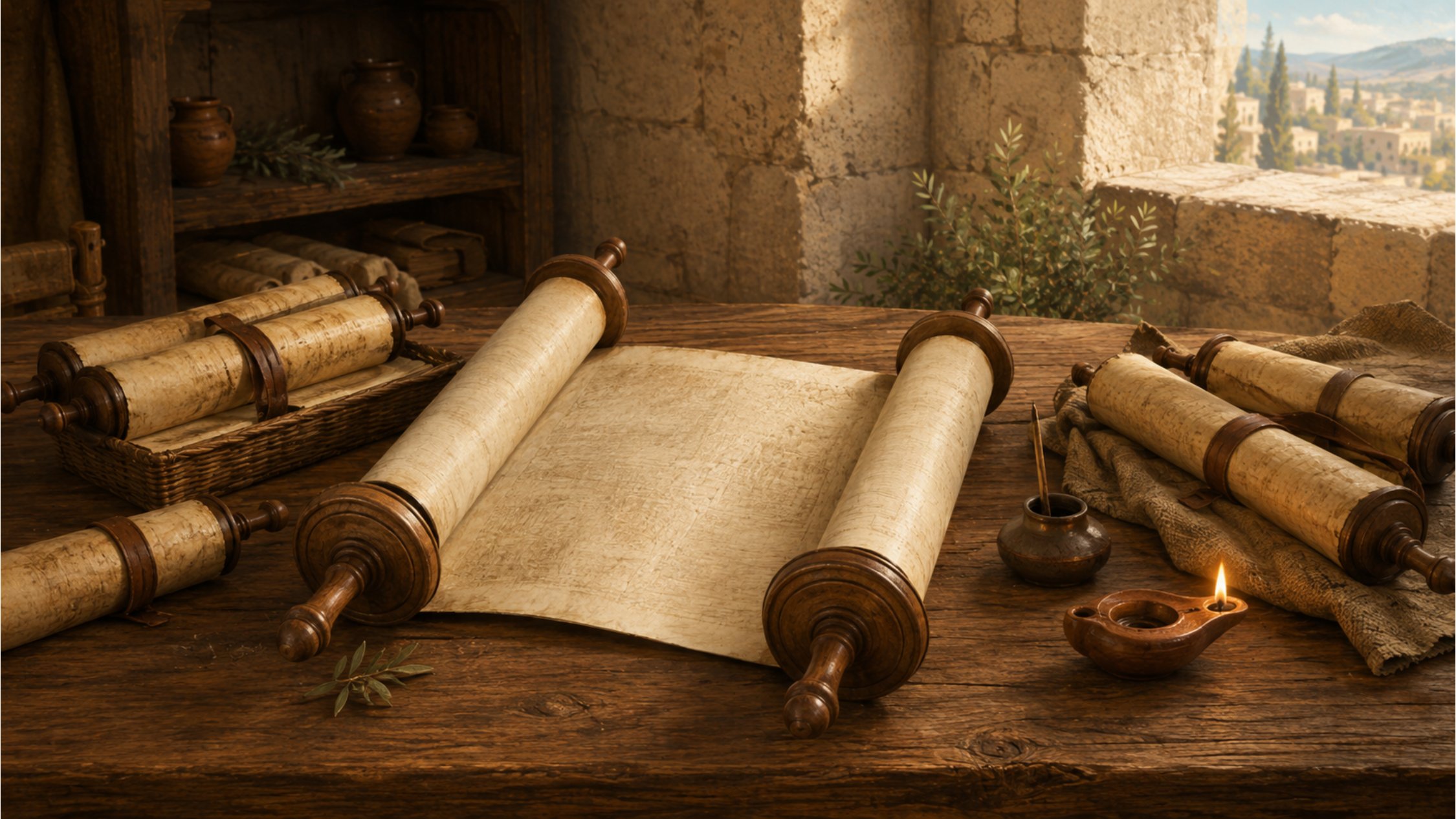
When we hear the word Bible, most of us picture a single book. We may think of the one on our nightstand, the family Bible on a shelf, or even the Bible app on our phone. We are used to Genesis being in the front, Revelation being in the back, and everything arranged neatly in between.
But for most of biblical history, Scripture did not exist that way.
There was no single bound Bible that someone could pick up and carry around. Instead, there were scrolls, separate writings, collections, letters, and copies made by hand. People often experienced Scripture by gathering together and listening as it was read aloud.
Once we understand that ancient world, many later questions about manuscripts, canon, and translation begin to make much more sense.
Scripture Was Often Heard Before It Was Read
In the time of Jesus, most people did not own personal copies of Scripture. Writing materials were expensive, books took time to produce, and every copy had to be made by hand. Because of that, Scripture was often heard in community rather than read privately at home.
We see this clearly when Jesus returned to Nazareth. Luke tells us that He entered the synagogue, stood to read, and was handed the scroll of Isaiah. After reading, He rolled the scroll back up, returned it to the attendant, and began teaching.
That simple scene gives us a good picture of how Scripture lived among ordinary people. They heard the words read aloud. They remembered them. They talked about them. Parents taught them to their children, and teachers explained them in the synagogue.
For many people, Scripture first entered the heart through the ear.
The Bible Was Not Yet One Book
The writings we now call the Old Testament were written and gathered over many centuries. Genesis was not written at the same time as Isaiah, and Isaiah was not written at the same time as Daniel. Psalms were collected over time, and other writings came later.
These writings were copied and preserved separately. A synagogue might have a Torah scroll, a scroll of Isaiah, a collection of Psalms, or other sacred writings. Larger collections certainly existed, but that is not the same as saying everyone had one complete Bible in one volume.
The New Testament developed in much the same way. Matthew circulated as its own Gospel, and so did Mark, Luke, and John. Paul’s letters were originally sent to different churches. Some were later copied and shared with other communities.
At first, nobody had a small leather-bound New Testament with twenty-seven books and gold-edged pages.
That came much later.
Scrolls Came Before the Books We Know
Most early Jewish Scripture was written on scrolls. A scroll was made from sheets joined together and rolled for storage. To find a passage, the reader had to unroll the scroll until reaching the right place.
That is very different from turning to a page number.
Later, Christians became early users of another format called the codex. A codex had pages bound together along one side, much like a modern book. This made it easier to move back and forth between passages and also made it possible to place more writing into a single volume.
Over time, the codex helped make larger collections of Christian writings much more practical.
It was one of the small steps toward the Bible as we know it today.
Scripture Was Written in More Than One Language
The Bible did not begin in English.
The Old Testament was written mostly in Hebrew, with some sections in Aramaic. The New Testament was written in Greek. That alone tells us why translation became such an important part of the Bible’s history.
As Jewish people lived in different parts of the ancient world, many began speaking Greek in everyday life. Some no longer understood Hebrew well enough to follow Scripture easily, so translations became necessary long before Christianity began.
Greek translations of Jewish Scripture were already being used before Jesus was born.
Later, as Christianity spread into places where people spoke Latin, Syriac, Coptic, Ge’ez, and other languages, Scripture crossed into those languages too.
The Bible has been crossing language bridges for a very long time.
Translation Was Never a Simple Job
Sometimes we think translation differences are a modern problem because we notice that one English Bible may phrase a verse differently from another. But translators have always had to make choices.
A Hebrew or Greek word may have more than one possible English meaning. A phrase that sounded perfectly natural in the ancient world may sound awkward if translated word for word today. Grammar works differently from one language to another, and sometimes a translator has to decide whether to stay close to the original wording or make the meaning clearer.
That does not mean translation is untrustworthy.
It simply means translation involves real human judgment.
Later in this series, we will look more closely at how those choices can affect meaning and why comparing translations can sometimes be helpful.
Every Copy Had to Be Made by Hand
Before the printing press, every copy of Scripture had to be handwritten. If a synagogue needed another Torah scroll, someone had to copy it. If a church wanted another copy of a Gospel, someone had to write it out. If Paul’s letter was going to be shared with another congregation, a copy had to be made.
That kind of work could be done with tremendous care, but human beings were still human beings. A copyist could accidentally skip a line, repeat a word, change a spelling, or copy a note into the text that had originally been written in the margin.
Most of these differences were small, but they help explain why ancient manuscripts are not always identical.
At first, that can sound unsettling. Yet there is another side to it that is very important.
Because many handwritten copies survived, they can be compared.
That means differences can often be seen rather than hidden.
Scribes Took Their Work Seriously
The people who copied Scripture carried a great responsibility. In Jewish tradition especially, sacred texts were copied with great care, and later scribal practices became highly detailed in an effort to protect the wording.
That does mean no mistakes ever happened, but it does tell us that the people doing the work knew they were handling something important.
Early Christians also copied their writings widely. As the message of Jesus spread, more copies were needed, and those writings began traveling from one community to another.
That wide circulation mattered. A text did not remain locked away in one place. Copies traveled to different regions and were preserved by different communities, which later gave scholars more evidence to compare.
The Synagogue Helped Keep Scripture in Public Use
Synagogues were important places for reading and teaching Scripture. Jesus regularly attended synagogue, and so did His earliest followers.
The Torah was read. The Prophets were read. Teachers explained what people heard, and the community discussed and remembered those words together.
The same pattern carried into early Christian gatherings.
Paul gives us a little glimpse of this when he writes:
“After this letter has been read at your gathering, have it read also in the church of the Laodiceans; and see that you also read the letter from Laodicea.”
— Colossians 4:16
That verse tells us something very practical. A letter written to one church could be read in another. Copies could be made, and the writing could travel far beyond its original audience.
That is one of the ways collections began to grow.
Chapters and Verses Came Much Later
Another thing we often forget is that the earliest manuscripts did not have the chapter and verse numbers we use today.
Jesus never said, “Turn to Matthew 6:33.”
Those numbers did not exist.
Ancient writings were read as continuous text. Chapter divisions came much later, and the verse numbering used in most modern Bibles came later still.
Those divisions are extremely helpful, especially when we want to find a passage quickly or study together. But they are not part of the original writing.
Remembering that can sometimes help us read better. A verse may sound one way when pulled out by itself and quite different when read as part of the whole paragraph around it.
Not Every Community Had Every Writing
Because writings had to be copied by hand and physically carried from one place to another, not every synagogue or early church had access to the same collection at the same time.
One community might know a writing well, while another had barely heard of it. A book could be widely used in one region and less familiar in another.
That becomes important when we later talk about canon.
Some differences between early Christian communities may have had less to do with stubbornness or bad faith and more to do with something very simple: geography and access.
The ancient world moved slowly.
A writing had to travel.
The Earliest Christians Inherited Jewish Scripture
The first followers of Jesus did not begin Christianity with a blank page. They already knew and used the Scriptures of Israel.
They heard them in synagogue, quoted them in teaching, and used them to explain who Jesus was. The New Testament is filled with Old Testament language, stories, images, and quotations because the earliest Christians believed those writings were part of the same story God was continuing through Jesus.
Later, new writings about Jesus and the apostles were copied and shared alongside those older Scriptures. Over time, these collections would come to be known as the Old Testament and New Testament.
But that happened gradually.
It did not happen all at once.
Before There Was a Bible
So before there was one Bible sitting neatly on a shelf, there were many pieces of the story. There were ancient Hebrew writings, Greek translations, scrolls being read in synagogues, letters moving from church to church, and stories of Jesus being written, copied, and passed along.
It may sound a little less tidy than what we are used to, but it helps us understand how Scripture actually came to us.
And I think there is something rather beautiful about that.
These writings survived because generation after generation believed they mattered enough to copy, carry, read, teach, and share.
In the next chapter, we will look more closely at how the Old Testament was preserved and what ancient discoveries such as the Dead Sea Scrolls can tell us about the Scriptures Jesus and the Jewish people knew.
