
Was the Bible Changed by Men
What the Manuscripts, Copying, and Translation Really Show
“Your word is a lamp for my feet and a light on my path.”
— Psalm 119:105 (CSB)
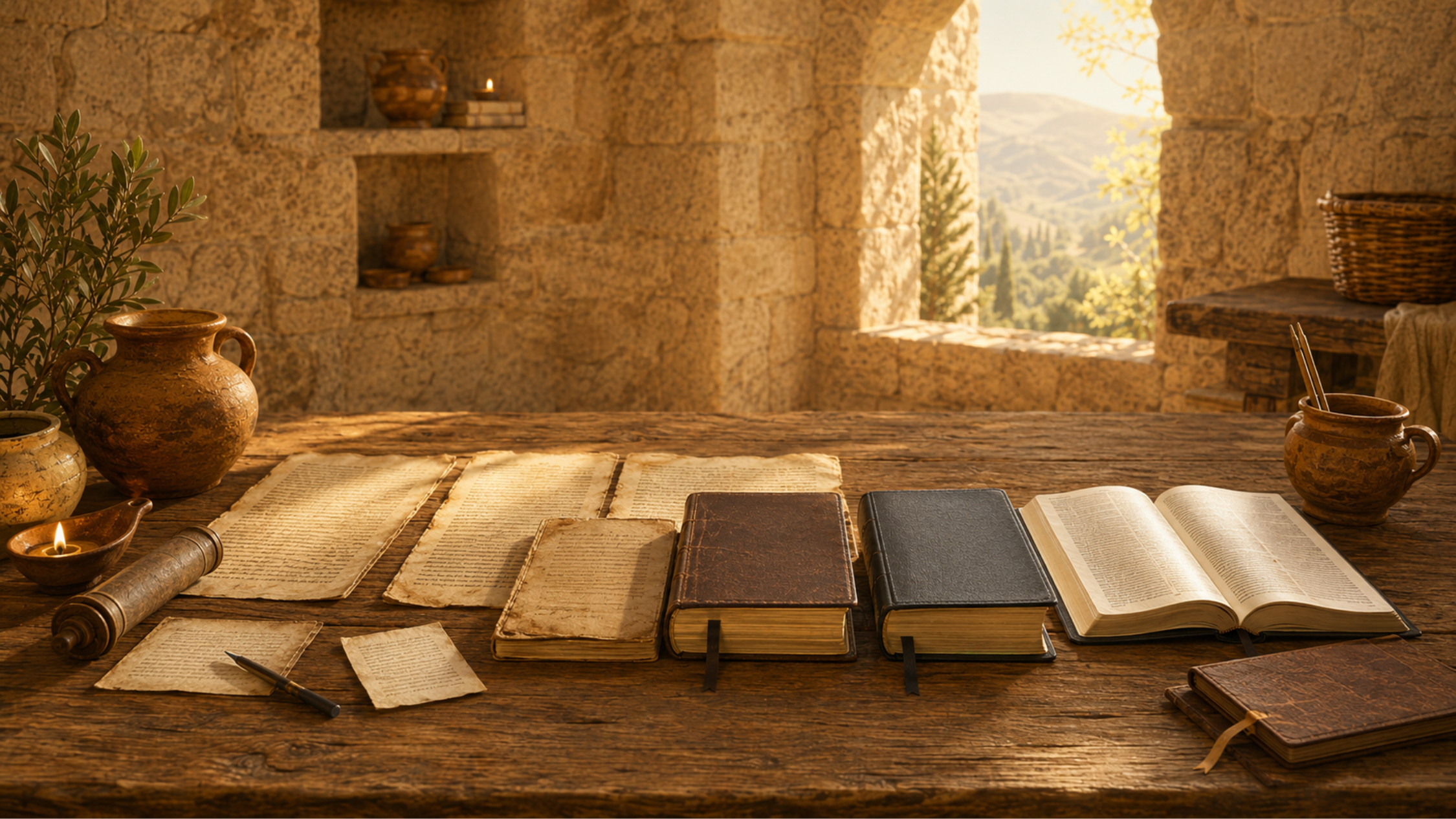
This is one of the biggest questions people ask once they begin learning how the Bible came to us.
If human beings wrote the books, copied them by hand, translated them into other languages, gathered them into collections, and sometimes disagreed about which books belonged, then was the Bible changed by men?
The most honest answer is that human beings were involved at every stage. That part is true. But it does not follow that the Bible was simply rewritten however people pleased.
The history is more careful than that.
The Bible Passed Through Human Hands
The writings of Scripture were written by people. They were copied by people. They were carried from one place to another, translated into new languages, and eventually gathered into larger collections.
That means we should not pretend there was no human process.
But those same human hands also left behind evidence.
Ancient manuscripts survived. Early translations survived. Quotations in Jewish and Christian writings survived. Different copies can be compared with one another, which allows scholars to see where wording stayed stable and where differences appeared. Our outline for this chapter puts the point simply: the Bible passed through human hands, but those hands left behind manuscripts that can be compared.
That is much more useful than simply saying, “Nothing ever changed.”
Some Things Did Change in Copying
Whenever a long document is copied by hand, small differences can appear.
A copyist might skip a word, repeat a phrase, change a spelling, or accidentally move from one similar line to another. Sometimes a scribe may have tried to make a difficult sentence clearer or make one Gospel passage sound more like another familiar passage.
These differences are called textual variants.
The phrase sounds more alarming than it usually is.
Most variants are small. They may involve spelling, word order, or wording that does not change the basic meaning of the passage.
A smaller number are more important and deserve careful study.
The important thing is that the differences are visible.
They can be examined.
Why Many Manuscripts Help
It may seem strange, but having many copies is actually helpful.
If we had only one ancient manuscript, we would have no way to know whether a copying mistake had slipped into it.
But when many manuscripts survive, scholars can compare them.
Suppose ten old copies of a passage agree and one has an extra word. That does not automatically prove the ten are right, but it gives scholars evidence to examine. They can also look at the age of the manuscripts, the region they came from, and which reading best explains how the others may have developed.
In other words, the differences do not disappear because we ignore them.
They become understandable because we can compare them.
Translation Changes Wording Without Necessarily Changing Meaning
Another kind of change happens when Scripture moves from one language to another.
Hebrew, Aramaic, and Greek do not line up perfectly with English. Translators have to make choices about wording, grammar, idioms, and sentence structure.
That means an English Bible will not look exactly like the Hebrew or Greek word for word.
But that is what translation is.
The question is not whether the wording changes when a text moves into another language. Of course it does.
The better question is whether the meaning is being carried faithfully.
Most differences between reliable English translations come from that normal process rather than from someone trying to rewrite Scripture.
Could Theology Influence the Wording?
As we saw in the last chapter, theology can sometimes influence translation choices because translators are human.
That does not mean most translators are trying to manipulate the Bible. Usually they are making difficult decisions about words that can be understood in more than one way.
This is one reason comparing translations can be helpful when a passage seems especially important or unclear.
If one translation sounds very different from several others, that is a good place to slow down and look more carefully.
The goal is not suspicion.
It is understanding.
What About Verses That Are Missing in Some Bibles?
This is one of the places where readers often become worried.
A modern translation may place a verse in brackets, move it to a footnote, or note that some ancient manuscripts do not contain it. Someone comparing that Bible with an older translation may think, “Why did they remove this?”
Usually the reason is manuscript evidence.
Some passages appear in later manuscripts but are absent from earlier ones. Modern translators may therefore place the wording in a note or mark it so the reader knows there is a question about whether it was part of the earliest recoverable form of the text.
That is not the same as secretly removing Scripture.
In fact, the footnote is showing the reader exactly where the uncertainty is.
Were Passages Ever Added?
Sometimes later manuscripts do contain words or passages that do not appear in earlier copies.
That can happen for ordinary reasons. A margin note may have worked its way into the text. A familiar phrase may have been added to make a passage clearer. A scribe may have harmonized one Gospel with another.
Again, we should not be afraid to say that.
The existence of such changes does not mean the whole Bible was rewritten.
It means handwritten transmission has a history.
And because the manuscripts survive, that history can often be traced.
What About the Canon?
The canon is another place where human decisions mattered.
Different Jewish and Christian communities did not always preserve exactly the same collection of books. Later traditions formalized different boundaries, especially in the Old Testament.
So in that sense, people certainly played a role in deciding which books were copied together, read publicly, and treated as Scripture.
But that is different from saying people changed the wording of every book to suit themselves.
Canon asks which books belong in the collection.
Textual criticism asks what the wording of those books most likely was.
Translation asks how those words should be expressed in another language.
Those are related questions, but they are not the same question.
Did Religious Leaders Deliberately Rewrite the Bible?
There have certainly been individuals throughout history who tried to shape religion for their own purposes, and there have been theological disputes that affected how passages were interpreted.
But the idea that one group of leaders simply rewrote the entire Bible and successfully replaced all earlier copies does not fit the manuscript evidence very well.
Texts were spread across many regions.
Different communities had copies.
Translations existed in more than one language.
Churches that disagreed with one another still preserved many of the same writings.
That makes a complete hidden rewrite much harder to imagine.
There were too many copies in too many places.
What About Inspiration?
For many Christians, there is also a faith question here.
If Scripture is inspired by God, how can there be copying differences or translation choices?
The simplest answer is that inspiration and transmission are not exactly the same thing.
Christians may believe God inspired the biblical writings while also recognizing that later copies were made by ordinary people. Those copyists could make mistakes without changing the fact that the writings themselves were regarded as sacred.
The same is true of translation. A translator can make a poor choice without that meaning God’s Word has disappeared.
Faith in inspiration does not require pretending the human history never happened.
What Can We Still Know?
This is perhaps the most reassuring part of the story.
Because so much manuscript evidence survives, scholars are usually able to identify the wording of the biblical text with a high degree of confidence. Most differences are small, and the major teachings of the Bible do not generally depend on one uncertain word or one disputed verse.
There are places where uncertainty remains.
We should say so.
But uncertainty in a few places does not make everything uncertain.
That is a lesson we have seen several times in this series.
So, Was the Bible Changed by Men?
If by “changed” we mean, “Did human copying and translation introduce differences?” then yes, in small and traceable ways.
If by “changed” we mean, “Was the Bible secretly rewritten so thoroughly that we can no longer know what the ancient writings said?” the evidence does not support that conclusion.
The better answer is more balanced.
The Bible passed through real human hands. Those hands sometimes made mistakes, sometimes made translation choices, and sometimes disagreed about canon. But they also preserved a large body of manuscripts that can be studied and compared.
We do not have to choose between pretending nothing ever changed and assuming everything was corrupted.
The evidence gives us a more reasonable middle ground.
What We Can Say
The Bible has a human history, and that history is visible. Manuscripts differ in places. Translations use different wording. Canon traditions are not identical. None of that needs to be hidden.
At the same time, the surviving evidence is strong enough for us to study where changes occurred and where the text remained stable.
That gives us something better than blind confidence.
It gives us confidence that has been tested.
In the next chapter, we will bring everything together and ask one final question:
After all of this, what can we be confident about?
