
Back to the One the Scriptures Reveal
Why the Journey Through History Can Strengthen Our Trust
“You pore over the Scriptures because you think you have eternal life in them, and yet they testify about me.”
— John 5:39 (CSB)
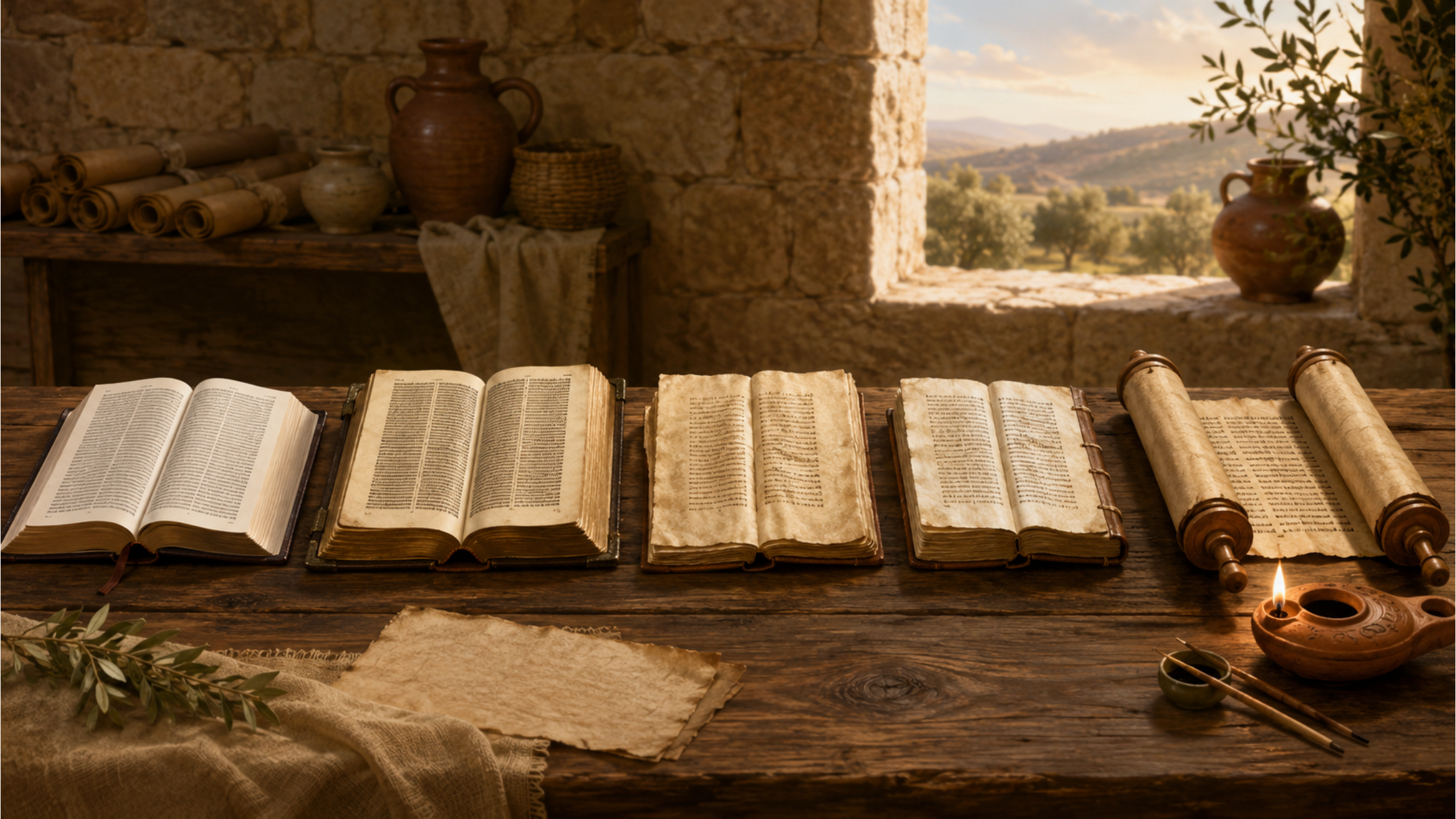
We began this journey with a Bible already in our hands. Genesis was at the beginning, Revelation was at the end, and the books in between were arranged in a familiar order. Most of us never had much reason to think about the long path those writings traveled before they reached our shelves, our churches, or the Bible app on our phone.
Now we have looked behind the cover.
We have seen ancient scrolls, handwritten manuscripts, Hebrew and Greek, early translations, lost letters, Christian writings that were valued but not accepted everywhere as Scripture, different canon traditions, and generations of people who copied, shared, translated, and preserved these words.
The history is more complicated than a simple sentence can explain, but that does not make the Bible less trustworthy.
In many ways, it gives us more reason to appreciate how much evidence has survived.
The Scriptures Jesus Knew
Long before there was a New Testament, Jesus knew the Scriptures deeply.
As a boy, He amazed the teachers in the Temple with His understanding. As an adult, He read Isaiah in the synagogue, answered temptation with Deuteronomy, referred to Genesis when teaching about marriage, quoted the Psalms, and drew again and again from the Law and the Prophets.
Scripture was woven into the way Jesus taught and understood the work of God.
After His resurrection, Luke tells us:
“Then beginning with Moses and all the Prophets, he interpreted for them the things concerning himself in all the Scriptures.”
— Luke 24:27
Jesus did not treat Scripture as a collection of old religious sayings that had lost their meaning. He showed His followers how the writings they already knew were part of the larger story of God’s faithfulness, mercy, promise, and redemption.
That is one of the strongest reasons Scripture remains important to Christians today.
Jesus loved it, quoted it, trusted it, and taught from it.
The History Does Not Take Away From the Word
Throughout this series, we have tried to be honest about the human side of the Bible’s history. People copied manuscripts by hand, and small differences appeared. Translators sometimes chose different words. Early communities did not always agree immediately about every book. Different Christian traditions eventually inherited somewhat different Old Testament collections.
None of that means the Bible disappeared beneath human error.
Quite the opposite.
Because manuscripts survived, we can compare them. Because ancient translations survived, we can see how Scripture was understood in different languages. Because early Christians quoted the books they were reading, we can trace how those writings were being used. Even the places where manuscripts differ are usually visible rather than hidden.
We are not left with a mystery and told simply to trust.
We have evidence we can examine.
The Central Message Has Remained Clear
One of the most encouraging things we discovered is that the central message of Scripture does not depend on one uncertain word, one disputed verse, or one debated book.
The story of God’s work runs throughout the Scriptures.
God creates, calls, corrects, forgives, restores, and keeps reaching toward people. The prophets call people back to Him. The Psalms give words to worship, grief, hope, repentance, and trust.
Then Jesus comes into that story and reveals the Father with remarkable clarity.
He teaches people to love God and love their neighbor, to forgive, show mercy, turn back to God, trust the Father, seek His Kingdom, and follow Him. The Gospels preserve His life, His teaching, His death, and the testimony of His resurrection.
Those truths are not hanging by one fragile thread.
They are woven throughout the biblical witness.
The Bible Has Survived a Remarkable Journey
It is worth thinking about how much had to happen for us to hold these writings today.
Ancient texts had to be copied again and again. Scrolls had to survive wars, migrations, persecution, climate, and ordinary decay. Scriptures moved from Hebrew into Greek and then into many other languages. Christian writings traveled from church to church, sometimes over great distances.
Generations of people preserved these words because they believed they mattered.
Some of those people are known to history.
Most are not.
But their work remains.
There is something beautiful about that.
A scribe copying Isaiah could never have imagined someone reading those same words thousands of years later on a glowing screen halfway around the world. Yet here we are.
God Was Not Absent From the Story
Christians also see something more than human effort in this history.
Jesus promised His followers that the Holy Spirit would teach, remind, and guide them into truth. The New Testament shows believers praying, teaching, remembering, writing, traveling, and making decisions while trusting that God was working among them.
That allows us to hold two truths together.
The Bible has a real human history, and Christians can still believe God worked through that history.
Those ideas do not have to compete.
Faith does not require us to pretend scribes never made mistakes or that every church leader made a perfect decision. It allows us to believe that God can work through ordinary people who are still learning, thinking, and sometimes getting things wrong.
He has always worked through people like that.
We Can Ask Questions Without Losing Trust
One of the hopes of this series is that readers will never again feel that a difficult question about the Bible has to be frightening.
If someone mentions the Dead Sea Scrolls, we know why they matter.
If a Bible footnote says, “Some manuscripts read differently,” we understand what that means.
If someone says Catholic, Orthodox, or Ethiopian Bibles contain additional books, we know there is a long history behind those differences.
If two Bible translations use different wording, we know that translation requires judgment and that we can look more closely when the difference matters.
Questions do not have to threaten faith.
Sometimes they help faith grow roots.
Jesus Still Helps Us Find the Center
After everything we have studied, I think Jesus gives us the best place to stand.
He knew Scripture more deeply than the religious leaders who tried to trap Him with it, yet He never made God seem available only to experts. He could discuss Scripture in the Temple and then walk outside and teach a farmer through a story about seed.
Jesus kept bringing people back to what mattered.
Love God.
Love your neighbor.
Show mercy.
Forgive.
Trust the Father.
Seek His Kingdom.
Follow Me.
The Bible contains history, poetry, prophecy, wisdom, letters, visions, laws, and stories written across many centuries, but Jesus helps us see the heart running through it.
He shows us what God is like.
The Father, the Son, and the Holy Spirit
The story also brings us back to God in His fullness.
Jesus taught us to pray to the Father and trust His care. He showed us that the Father was not distant and unreachable but knew what His children needed.
Jesus Himself became the way through whom people came to the Father.
And He promised the Holy Spirit as Helper and Teacher.
So when we open Scripture, we are not simply studying an ancient religious collection. Christians believe we are listening for the truth of God, looking toward Jesus, and asking the Holy Spirit to help us understand and live what we read.
That gives Bible reading both humility and hope.
The Bible Is Worth Trusting and Worth Reading
After everything we have learned, I do not think the right response is to put the Bible down because its history involved human hands.
I think the better response is to pick it up with greater appreciation.
We know more now about how carefully these writings were copied, how widely they circulated, how much evidence survives, and how the central message remained recognizable across languages, cultures, and centuries.
We can read with open eyes.
We can notice footnotes.
We can compare translations.
We can ask questions.
And we can still trust that these Scriptures have faithfully carried the story of God and the witness of Jesus to us.
Back Where We Began
At the beginning of this series, we said that knowing how we got the Bible matters, but knowing the God it reveals matters even more.
After everything we have studied, I think that remains true.
The manuscripts matter because they preserve the words.
The canon matters because it tells us which writings different communities received as Scripture.
Translation matters because people need to understand those words.
History matters because faith does not need to be afraid of truth.
But the purpose of all of it is not simply to know more facts about an ancient book.
It is to hear the message those words have carried across the centuries.
The Scriptures Jesus knew, loved, quoted, and explained still call us toward the same God He taught people to trust. They prepare the way for the story of Jesus, and the New Testament preserves the witness of those who followed Him and carried His message into the world.
The road these writings traveled was long.
But the message made it through.
And that gives us good reason to open the Bible with confidence, ask the Holy Spirit for wisdom, and keep listening for the God who has been speaking through its pages for a very long time.
