
How We Got the Bible
“You pore over the Scriptures because you think you have eternal life in them, and yet they testify about me.”
— John 5:39 (CSB)
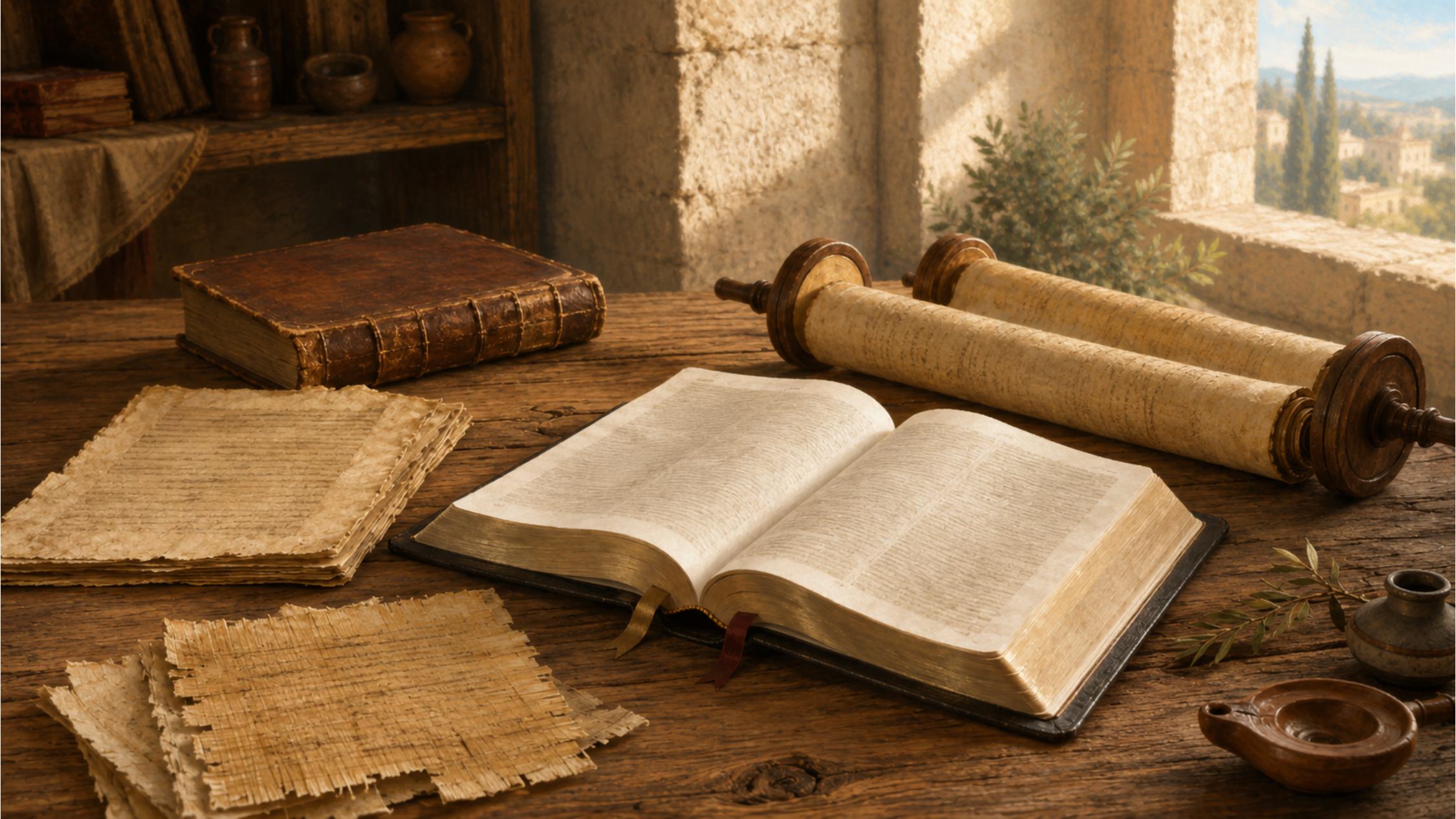
Most of us first met the Bible as a finished book.
We picked it up with Genesis at the beginning and Revelation at the end. It had a table of contents, numbered chapters and verses, and perhaps a ribbon tucked between the pages. It was easy to assume that the Bible had always existed in something close to the form we hold today.
But its story is much longer than that.
The Bible came to us through thousands of years of writing, copying, preserving, collecting, translating, and sharing. The earliest Scriptures were written on scrolls. Copies were made by hand. The books we now find together in one Bible once circulated separately, sometimes across different countries and languages.
And once you start thinking about that, questions naturally come.
How do we know the words were preserved accurately? Who decided which books belonged in the Bible? Why do Catholic, Protestant, Orthodox, and Ethiopian Bibles contain different books? What about ancient writings such as Enoch? Did Paul write letters that have been lost? What is the source scholars call Q? Why do Bible translations sometimes say different things?
Those are reasonable questions.
We do not have to be afraid of them.
Beginning with Jesus
Our starting point will be Jesus.
Jesus knew the Scriptures deeply. He heard them from childhood, read them in the synagogue, quoted them when He taught, and used them when answering difficult questions. When Satan tempted Him in the wilderness, Jesus answered with Scripture. When religious leaders challenged Him, He often returned to Scripture. Even while suffering on the cross, words from the Psalms were on His lips.
Jesus also warned that Scripture and faith could become buried beneath human tradition.
He challenged religious leaders when rules and traditions began to hide the heart of what God had said. Yet when Jesus taught ordinary people, He usually spoke in ways they could understand. He talked about seeds, sheep, families, money, meals, vineyards, lamps, neighbors, and everyday life.
His teachings were deep, but they were not meant only for religious experts.
Jesus simply invited people:
“Come to me, all of you who are weary and burdened, and I will give you rest.”
— Matthew 11:28
Over the centuries, Christians developed traditions, institutions, theological systems, and religious practices. Some helped preserve and explain important truths. Others sometimes added layers that made the simple teachings of Jesus harder to see.
There is nothing wrong with wanting to understand Jesus more deeply. The trouble begins when our explanations start carrying more weight than His words.
That is why we will keep coming back to Jesus throughout this series.
God Has Not Left Us Alone
Jesus also promised His followers help.
“But the Counselor, the Holy Spirit, whom the Father will send in my name, will teach you all things and remind you of everything I have told you.”
— John 14:26
The Holy Spirit was not given to replace careful thinking, Scripture, or discernment. He was given as Helper and Teacher.
Christians therefore have good reason to believe that God continued working among His people as the message of Jesus spread and His teachings were remembered, written, copied, and shared.
Many Christians also believe the Holy Spirit helped guide the recognition of Scripture. We can hold that belief while still being honest about what history can and cannot prove.
History can show us which books were copied, quoted, shared, questioned, and accepted. It can show us ancient manuscripts and the writings of early Christians. It can even show us places where different groups of believers did not agree.
But history cannot measure the work of the Holy Spirit.
Faith and historical evidence are not enemies. They simply do not always answer the same questions.
Human Beings Can Be Wrong
Jesus promised the Holy Spirit, but He also warned His followers that false teachers would come.
He warned about people who appeared righteous but led others in the wrong direction. He confronted religious leaders who placed heavy burdens on ordinary people, and He challenged traditions that had begun to take the place of what God actually intended.
Because of that, we should not assume that every decision made by a church leader, council, translator, teacher, or religious institution was automatically approved by God.
But neither should we assume that every disagreement came from bad motives.
People can sincerely love God and still get something wrong. We all can.
Throughout this series, we will try not to point fingers. We will not begin with the beliefs of one denomination and then work backward trying to prove that its Bible is the right one. Instead, we will look as closely as we can at the earliest evidence. We will pay special attention to the Scriptures Jesus used, the writings His earliest followers knew, the books early Christians copied and shared, and the places where they agreed or disagreed.
And when the evidence does not give us a clear answer, we will simply say so.
Sometimes “we don’t know” is the most truthful answer we have.
A Bible That Passed Through Human Hands
One thing becomes clear very early in this journey: God did not hand humanity a completed, leather-bound Bible.
The books were written by people. They were copied by people, carried from place to place, translated into new languages, and eventually gathered into collections. Along the way, people sometimes made mistakes.
That can sound uncomfortable at first.
But those human hands also left evidence behind.
Ancient manuscripts can be compared. Different readings can be examined. Early translations can be studied. Quotations from Scripture in ancient writings can be traced. We can often see where copying differences happened rather than pretending they never happened.
The history of the Bible is not hidden from us.
We can look.
When Translations Differ
We will also discover that translating the Bible requires choices.
Hebrew, Aramaic, and Greek do not always fit neatly into English. Sometimes several English words could reasonably express one ancient word. Grammar can work differently. Expressions that made perfect sense two thousand years ago may sound strange if translated word for word today.
And yes, sometimes a translator’s religious beliefs can influence which meaning seems most natural.
That does not mean we cannot trust Bible translations. It simply means that when an important passage reads quite differently from one Bible to another, it may be worth slowing down and looking more carefully.
We can compare several translations, look at the surrounding passage, and when necessary look behind the English to the original language.
The goal is not to make everybody a Hebrew or Greek scholar.
We are simply trying to understand what the biblical writer was most likely saying.
The Books in Our Bibles
We will also look honestly at the question of canon—the collection of books recognized as Scripture.
Different Christian traditions do not all contain exactly the same Old Testament books. Ancient Jewish and Christian communities did not always preserve identical collections either.
Rather than beginning by declaring that one later tradition must be correct, we will move toward the earliest evidence we can find. We will give special weight to the Scriptures Jesus quoted or referred to and to the writings used by His earliest followers.
We will also look at books such as Enoch without dismissing them because they seem unfamiliar and without declaring them Scripture simply because they are ancient.
Some questions will have strong answers, while others may remain uncertain.
That is all right.
Faith does not require us to pretend we know something that history cannot tell us.
Why We Are Taking This Journey
This series is not meant to make the Bible more complicated.
Really, I hope it does the opposite.
Over many centuries, arguments, traditions, theological terms, and religious practices have sometimes piled up until ordinary people begin to feel that Scripture is something only experts can understand.
But that was not how Jesus taught.
Jesus sat with ordinary people. He taught fishermen and farmers, mothers and widows, laborers and merchants. He talked about loving God and loving our neighbor, forgiving people, showing mercy, turning back to God, trusting the Father, seeking His Kingdom, and following Him.
There is great depth in Scripture, and good teachers and scholars can help us understand its language, history, and culture. We should be thankful for that help.
But good teaching should help us see God more clearly, not become another wall between Him and us.
So as we begin How We Got the Bible, our purpose is not simply to learn the history of an ancient book.
We are following the path by which these Scriptures reached us. Along the way, we will meet scribes and translators, apostles and early Christians. We will look at ancient manuscripts, disputed books, lost letters, different canons, and questions people have been asking for a very long time.
Through it all, we will keep coming back to God, to the teachings of Jesus, and to the help of the Holy Spirit.
Because knowing how we got the Bible matters.
But knowing the God it reveals matters even more.
